7 Oct 2011

Exhibition: "BELVEDERE - Warum ist Landschaft Schön - Why is Landscape Beautiful ?"

Installation by Cave Research Department and The Department of Subterranean Landscapes 
in arp museum Bahnhof Rolandseck Germany, 4. september 2011 -  4. march 2012 


ENLARGE: click the images
Photos: Jussi Kivi


Link to the web pages of the museum


Jussi Kivi: Interim Report on the Landscape and Cave Research Department

'No voyages of discovery are made in a
world of matters of course.’ 

Grotta is the italian word for all kinds of caverns and grottos. In historico-cultural terms, however, the term derives from the underground temples and holy caverns of antiquity. Since the Baroque period the grotto has become a standard curiosity in the european landscape garden. In the romantic era an artificial grotto came increasingly to symbolise an element of the wild in the artificial landscape to which the art of landscape gardening was devoted. The grotto is a symbol of access to prehistoric depths, to the chambers of hermit monks and to metaphors of the underworld and the subconscious.
CAVE-PAINTING

During World War I the russians built a ring of fortifications around my hometown Helsinki as part of a broader strategy to defend St. Petersburg. The October revolution brought this huge undertaking to a standstill and Finland gained independence shortly afterwards. Among the most impressive structures still in existence today rank the trenches cut deep into the cliffs and the circa one hundred caverns intended initially for use as ammunition depots and bomb shelters. The army and the arms industry actually used some of them as such during World War II, after which they were put to various purposes. Some were swallowed up by urban development yet a few abandoned or never completed caverns can still be found in the forests on the city outskirts. The granite walls of the trenches leading to the caverns are covered by moss that has grown undisturbed there for decades. Today, some of the trenches look like a natural phenomenon, an impression underscored in the best cases by sylvan wilderness and lush undergrowth. Civilisation lends the place a particular aura too, with a hotchpotch of metal scrap and rubbish piled up over years. This heightens the anti-social profile often attributed to the modern suburban forest. Young people have used the caverns there as alternative ‘youth clubs’, which has given rise to all kinds of things of a sort that might better go unnoticed. Homeless people have evidently camped in the caverns too, although these are damp, cool and anything but comfortable. Not that one runs into people here often, though their traces are everywhere to see. These are places where people evade anyone who threatens to cross their path, places where anything might have happened ... 

I began to make irregular jaunts to these caverns towards the end of the 1980s. In the winter of 2002 I photographed one of the largest open caverns as an experiment. While making the shots I lit the dark cavern by flashing my torch around. Then I had typical small-sized prints made in a photo shop. All the images on the film were underexposed — with one exception. This one successful shot, however, which had cost me so much trouble to make, was highly significant; for although the focus of my work in the preceding years had been something else entirely, my interest in photography revived the moment I saw it. The reason was that this one photograph had something painterly about it — a quality way beyond the usual scope of photochemical production. It was evidently a case of a paranormal, art-historical phenomenon of sorts. The postcard sized print with which I left the photo shop suddenly morphed into a masterpiece of painting, entrusted to my care. I returned to the caverns and once again, seemingly portentous after-images began to take shape in the light cone of my torch. They beckoned from the depths like spirits of the underworld. And the underworld from which they sprang was the tradition of a certain type of darkly coloured european painting.


 Salvatore Rosa: Landscape with Hermit c.1662


The first to emerge from the shadows were numerous versions of Arnold Böcklin’s  Isle of the Dead as well as the cavern and abyss idylls of the frenchman Courbet, who was actually held to be a realist. At the entrance to the cavern was waiting the master himself, Caspar David Friedrich, whose nights, cliffs and landscapes of ruins are unrivalled everywhere — except in the natural world. The path into the thickening darkness pointed in this direction. I decided to apprentice myself to a master immediately and thereupon met another teacher: Leonardo and The Virgin of the Rocks, along with Altdorfer and Dürer, the ‘Albrechts’ of the sixteenth century. The list would not be complete without Hieronymus Bosch, the lesser-known landscape painter Roelant Savery and the, when not avant-garde then certainly experimental, Hercules Seghers. Italian Salvatore Rosa was also convincingly represented in these macabre galleries of the suburban forests, as was a string of lesser-known seventeenth century dutch painters and one or two German romantics. Every last one of them predated the invention of electric light. And Doré, of course, even though he was mainly a graphic artist. The forgotten tunnels transmogrified into museum halls and endless galleries. Sublime centuries of art spoke from the cliff face. I aspired now to higher things. My equipment consisted of a rather cheaper brand of Japanese camera, a tripod, a cable release, torches and an egg timer from the kitchen for long exposures. I usually set off on my photo expeditions only at dusk, so daylight would not impair the ambience. Slowly taking photographs in the dark often stretched the hours spent underground deep into the night. This too had an effect on the photographs. Likewise the underground odorous landscape plays a part in the proceedings. Just as a painter’s mood is lifted by the smell of oil paint and solvents, I, too, have something similar to confess. When I fill my nostrils with the first few hits of that archaic, simultaneously dry, damp and mildewed odour  so typical of underground caverns my body is racked by waves of inspiration and suspense.

Gustav Dore


THE CAVE RESEARCH DEPARTMENT
The world is not only a picturesque combination of nocturnal odours and light, however. It soon became evident that the character of the caverns might be investigated on other levels than painting. Further research was necessary. I had first researched archaeological inventories in order to locate caverns. Then I studied archives and laid my hands on a file containing ground plans of caverns from the period 1937–39. The caverns had been surveyed at the time on behalf of the Ministry of Defence as a means to assess the extent to which such forgotten underground spaces in the depths of the forests might be used in the case of a war. Equipped with copies of the ground plans I began new field studies. I updated and enhanced old maps by adding to their content the strata of civilisation found in the caverns — in a manner not unlike that used for archaeological excavation plans. All kinds of scrap and rubbish have been dumped in the caverns over the years, everything from broken bottles to the rusting corpses of bikes and iron beds and even burnt out cars. Some of the remains found there speak of underground activities: evidence of campfires for example, or wood dragged inside to be burned. Occasionally one even comes across ritual-mythical arrangements in the caverns, composed of fragments of mirror, candles or stones and twigs laid out in various forms, which have all disappeared by the time one returns or altered their form. 

In archaeology, examining finds is one of the primary research methods, and it can be applied equally to this kind of romanticist inquiry. The objective in this case, however, was not the distant past but the rich and constant permutations of subconscious life in wastelands and small forests on the urban periphery. The caverns themselves are portraits of a sort, depicting both the margins of civilisation and its inner core. They are the geological-expressionist and disregarded consequence of a macabre, megalomaniac policy, peppered with irrational contemporary addenda. Such disregard is tied up in turn with their message: that which the caverns reveal of a culture that brings forth such environments then shuns them.


Caspar David Friedrich
FURTHER RESEARCH: ONWARDS INTO THE DEPTHS

In addition to the aforementioned project, the scope of research was soon extended to include landscape research above ground into similar types of environment from the perspective of picturesque realism. The range of underground projects meanwhile spans more ambitious targets. Among these rank pits for the gain of primary materials and the underground networks indispensable to urban infrastructure. Activities in the cavern research sector have not been wholly unproblematic. Certain objectives have proved to be dangerous, and independent research into certain objects implies a measure of illegality and possibly undesirable juridical repercussions. It is for this reason that such activity, which in stylistic terms may rightly be called romantic, is presently attributed the additional mythical aura of underground art. It can indeed be seen as an impulse for the underground, for very little has happened in Western democracies in this field of landscape art for many years. To quote an anonymous twenty-first-century cave researcher:

‘You are of the earth and only in the earth can you grasp the infinity of the heavens [...] and the deeper, the closer to the core of all being we may wander, the weaker and more vulnerable this, our little spaceship, starts to feel. Earth [...] is our only home, only in her caverns are we safe; we cannot get any deeper than this ..."


John Martin: Bridge over Chaos 1826     

The text is published in the exhibition catalogue: 
"BELVEDERE  - Warum ist Landschaft schön? - Why is Landscape Beautiful" by arp museum Banhof Rolandseck, Germany 2011.


ENLARGE: Click the Images

7 Aug 2011

Jussi Kivi

Entrances I - topographical studies of light and shadow
Funnel quarry, north end seen from south
pencil 32 x 24 cm  2011
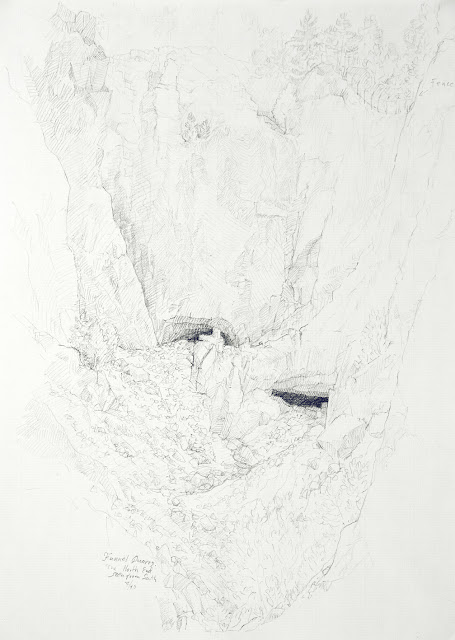


ENLARGE: Click the image

6 Aug 2011

Jussi Kivi: Tartaros, tunnels and deep giant stopes, map of level +80

ink on black paper 40 x 48 cm,  2011
(latin translation: Reijo Pitkäranta) 


ENLARGE: Click the image

Jussi Kivi : Tartaros, map sketch -level +80

ink, charcoal on tar paper, 25 x 20 cm, 2011


ENLARGE: Click the image


3 Aug 2011

Jussi Kivi: Tartaros - Sectio Longitudinalis - Black Damp

Giant underground stopes (worked out areas), tunnels and shafts, longitudal section of a mine.
- level +80 
- level +115 

Pastel on tar paper 117 x 175 cm,  Department of Subterranen Landscapes 2011


ENLARGE: Click the Image


Tartaros - Sectio Longitudinalis - Black Damp  (Detail)


ENLARGE: Click the Image


Jussi Kivi: Bayerischer Wald, part 1

walking trail 7.12.1993 1.30 pm - 5.30 pm
pencil 35 x 50 cm,  1993 


ENLARGE: Click the picture


III. Joint World Conference - MEETING OF THE GHOSTS

Organised by Romantic Geographic Society ( R.G.S.) and The School of Esoteric Geography (S.E.G)  ETC.  Helsinki, Finland 12.3.2011


Group shot of the participants in the map room


High level conversations during the break


Presentations and lectures were followed intensively at all levels


ENLARGE: Click the photos


Conference summary in finnish - link to the blog of The School of Esoteric Geograhpy

2 Aug 2011

II. World Conference - OUT OF MAP


II. World Conference organised by Romantic Geographic Society and The School of Esoteric Geography 27 -28 of Feb. 2010 in Suomenlinna fortress-island, Helsinki, Finland.


Group shot of participants at the old execution place
Photo: Veli-Matti Rintala

Link to conference summary in The School of Esoteric Geography blog (in finnish):


6 Oct 2010


The Biogas area, landscape from a former waste dump, Vuosaari, Helsinki
2005, 80 x 130 cm, Jussi Kivi photo.


ENLARGE: Click the image


30 Aug 2010


Cave 1242, Kivikko, Helsinki, 2006
Photo: Jussi Kivi


ENLARGE: Click the image


28 Aug 2010


Jussi Kivi: Naive, painted banner, Project Overtures am Wasser, Kunstcircolo - Alpines Museum, München, 2005


ENLARGE: Click the image


Campfire place in a cave with firewood, Mustavuori, Vantaa, Finland 2003
Photo: Jussi Kivi


ENLARGE: Click the image

16 Nov 2009

Besenhorster Sandberge fairies


Besenhorster Sandberge ruin area is in the outskirts of Hamburg.
In the days of second world war there was a nazi gunpowder factory with it's slave workers. 
The factory was bombed in the war and today the ruins are surrounded by forest.  
In this picturescue project  these forest ruins were photographed and renamed with
romantic names in the spirit of Schubert and other important german romantics.

The photographing project was a part of the exhibition and research project
 "Mapping a City, Hamburg Kartierung"  and it was shown atKunstverein in Hamburg 
 from november 2003 to february 2004. Photos: Jussi Kivi


House of Enigmas
Haus der Rätsel


ENLARGE: Click the image


Dwarfhouse
Zwergenhaus


ENLARGE: Click the image


Tree of Knowing
Baum des Wissen


Hottentot House
Hottentottenhaus


The Pavillon
Pavillon


ENLARGE: Click the image


Wanderer's Path
Plad der Wanderer


ENLARGE: Click the image


13 Oct 2009


Dorgarn - the uninhabited areas of Finland part 2 a
RGS camping and mapping department/ Jussi Kivi 1991


ENLARGE Click the image

7 Oct 2009

Installation in Ars Fennica 2009 exhibition


Dead spruce - dead pine, installation view (detail)


ENLARGE: Click the image


ENLARGE: Click the image


Forest edge - primeval forest in moonlight (detail)


ENLARGE: Click the image


First snow - small forest pond in the boreal forest belt surrounded by old forest and gradually being taken over by swamp vegetation in the moonlight after a snowfall. (Diorama)
Installation by Jussi Kivi in the exhibition Ars Fennica 2009 in Contemporary Art Museum Kiasma, Helsinki.


ENLARGE: Click the image

Jussi Kivi

Cave 1242 "Theater", Kivikko, Helsinki photo 81 x 121 cm, 2006


ENLARGE: Click the image

5 Oct 2009


"Korsvikin kirkko" - Korsvik Church",  Ground plan of a half-cave under huge erratic boulders near Loviisa, Finland.  Explanations: 1= camp fire site, 2= path to the sea (100m)
Cave research department/ Jussi Kivi


ENLARGE: Click the image


4 Oct 2009


Sewer Rat, Herttoniemi, Helsinki, 83 x 118 cm
photo: Jussi Kivi 2007


ENLARGE: Click the image


1 Oct 2009

An Expedition to the Little Night River 1995

In August 1995 a group of finnish, russian and komi biologists and artists mounted a joint expedition to the Voi-Vozh river valley in Komi, North Western Urals. 

The Voi-Vozh river runs between the Pechora plains and the Urals Mountains. It's a low tributary of the River Bol'shaya Synya which runs to river Usa, which in turn is a tributary of the Pechora River. In the Komi language, the points of the compass and the times of day are indicated with parallel constructions. The small southern branch of the river is called Day-River: the northern branch  is the Night-River.

The area is closed in by thick impassable forest, and is therefore entirely uninhabited.  It constitutes the single largest area of untouched forest on the European side of the continent. This remote and lonely region is dominated by dark forests, bogs, mountains, wild animals and millions of blackflies. Here, the human species (homo sapiens) exerts minimal influence. 
The place therefore affords unique opportunities for obseving  and studying "The UNTOUCHED."  
     The artistic aim of the expedition was to study untouched, pristine nature as a mytchical concept. This entailed viewing expedition itself as a mythical rite converging on pristine nature. The scientific interests focused on botany, zoology, ornithology, ecology and hydrobiology. Homever, the environment seemed supremely indifferent to our aims!

The expedition was organised by Pori Art Museum, Frame - finnish fund for art exhange and Komi University/ Biological department ( Syktyvkar. The Artistic results of the project was presented as a part of the exhibition "Strangers in the Arctic" 
in Rundetaar, Gopenhagen, The Art Museum of Atheneum, Helsinki and The Art Gallery of Ontario, Toronto. (1996-97)


Map: Ural mountains and Pechora plains in the surroundings
of River Voi-Vozh and River Vangyr. 1995


ENLARGE: Click the image


The horizon of Urals from north to south-east seen from the point: 65°57N/55°58E


ENLARGE: Click the image


Geological formations remind an ancient fortress,
 or a nose of a petrified Nenets soldier.
Jussi Kivi 1995-96


ENLARGE: Click the image


Melancholic evening at Voi-Vozh River
by the edge of Ural mountains and Pechora plains.


On the way to Pechora, river meanderings seen from the aeroplane.


Panorama Urals 270°,  from west to south
RGS exploration dept. / J. Kivi


ENLARGE: Click the image


 Sorbus Aucuparia (Uralin Pihlaja), Pinus Sibirica


ENLARGE: Click the image